How to Track AI Search Rankings: A Practical Guide

How to Track AI Search Rankings: A Practical Guide
AI search has no rank one. ChatGPT, Perplexity, Gemini, Claude and Google’s AI features write a fresh answer each time, so you track how often your brand is mentioned, cited and recommended across a fixed set of questions, repeated on a schedule. The routine below shows how to set that up, and where the weekly work is better handed to a team. Our done-for-you AI search visibility service runs that routine for brands and reports on it every week.
TL;DR
- There is no stable “position” in AI answers. Measure mention rate, citation rate and recommendation rate over many runs of the same prompts.
- Build a fixed prompt set of real buyer questions, run it on every engine your customers use, and compare against named competitors.
- Pair prompt tracking with analytics: Search Console for Google’s AI features, your web analytics for AI referral visits.
- Tracking only tells you where you stand. Gains come from technical fixes, answer-ready content and getting the content indexed.
- We do that work and send weekly reporting against competitors, so you see outcomes rather than a dashboard to interpret.
Table of Contents
- Why AI search rankings are not rankings
- Which engines to monitor
- Step 1: build a prompt set that mirrors buyers
- Step 2: run it many times, on a schedule
- Step 3: choose the metrics that matter
- Step 4: connect it to traffic you can see
- Step 5: read the results without fooling yourself
- Step 6: turn the findings into work
- What we do differently
- Perspective
- Get the tracking and the fixes in one service
- FAQ
- Sources
Why AI search rankings are not rankings
A classic Google results page is a list. You can say you are third for a keyword, and a rank tracker can check that daily. An AI answer is generated text. It may name three brands, five, or none, and it may link to sources or not. Ask the same question twice and the answer changes.
A widely cited January 2026 test by SparkToro and Gumshoe ran 12 prompts 2,961 times across ChatGPT, Claude and Google AI. The same list of brands came back less than 1% of the time, yet the leading brands in a category still appeared in a majority of answers. The lesson is that one check proves nothing, while a pattern over many runs is meaningful.
So the question changes from “where do I rank?” to three better ones:
- Mentioned: does the AI name your brand in its answer?
- Cited: does it link to or reference your pages as a source?
- Recommended: when the user asks for the best option, are you on the shortlist, and how is your brand described?
For a deeper look at the idea, see our explainer on brand visibility in AI.
Which engines to monitor
Track the engines your buyers actually use, and treat each one separately, because they draw on different sources and behave differently.
| Surface | What to record |
|---|---|
| ChatGPT (with search on) | Brand mentions, cited URLs, how you are described |
| Perplexity | Cited sources, which are shown for every answer |
| Google AI Overviews and AI Mode | Whether your domain is listed in the sources, which competitors appear |
| Gemini and Claude | Mentions and recommendations for category questions |
| Grok and other emerging assistants | Mentions, if your audience uses them |
Do not merge these into one score. An analysis of roughly 1.5 million answer snapshots reported that the cited domains for the same question differ widely between Google’s AI Overviews and AI Mode, and that churn from week to week is far higher in ChatGPT with web search than in AI Overviews. A blended number hides which engine is moving.
Step 1: build a prompt set that mirrors buyers
Your prompt set is your keyword list for AI search. It decides whether the data means anything.
Start with real questions. Pull them from sales calls, support tickets, your site search, and the People Also Ask boxes in Google. Write them the way a person talks to an assistant: full sentences, with context such as budget, company size or location.
Cover the buying journey. Mix three types:
- Category questions: “What are the best payroll tools for a 20-person company?”
- Comparison questions: “Brand A vs Brand B for small teams”
- Problem questions: “How do I cut onboarding time for new hires?”
Size it sensibly. One practitioner guide suggests 50 to 300 prompts per market, run repeatedly. A small business can begin with 30 to 50 prompts across its core services and grow from there.
Freeze it. Once the set is chosen, change it only deliberately and note the date. If you swap questions every month, you cannot tell whether your visibility changed or your test did.
Add competitors. Pick three to five rivals your buyers compare you with. Visibility only makes sense as a share against them.
Step 2: run it many times, on a schedule
Because answers vary, each prompt needs repeated runs on each engine. Three to five runs per prompt per engine is a workable minimum for a small set; more runs narrow the margin of error. Keep the conditions the same each cycle: the same location, logged-out or clean sessions, and the same search or browse setting.
Record, for every run:
- whether your brand was mentioned, and in what position within the list
- the sentence describing you, copied word for word
- every URL cited
- which competitors appeared
Then report frequency, not a single result. “We appeared in 38% of 120 runs on ChatGPT in November” is a reading you can compare next month. “We were third” is not.
Doing this by hand works for a first baseline and gets tedious fast: dozens of prompts, several engines, repeated runs, every week. That is the point where most teams either buy a monitoring tool or hand the job over.
Step 3: choose the metrics that matter
Keep the scorecard short. Four numbers cover most decisions.
| Metric | How to calculate it | What it tells you |
|---|---|---|
| Mention rate | Runs naming your brand ÷ total runs | Whether the AI knows you exist for this topic |
| Citation rate | Runs citing one of your URLs ÷ total runs | Whether your content is trusted as a source |
| Share of voice | Your mentions ÷ all brand mentions in the set | How you stack up against competitors |
| Sentiment and accuracy | Review the wording of each description | Whether you are described correctly and favorably |
Split each by engine and by prompt type. A brand often does well on problem questions and vanishes on “best of” comparisons, which is where purchase decisions happen. Our guide to AI brand mention tracking goes through each metric in more detail, and the same measurement ideas are laid out in a breakdown of relevant metrics for AI-generated answers.
Step 4: connect it to traffic you can see
Prompt tracking shows presence. Your analytics show whether presence sends people to you.
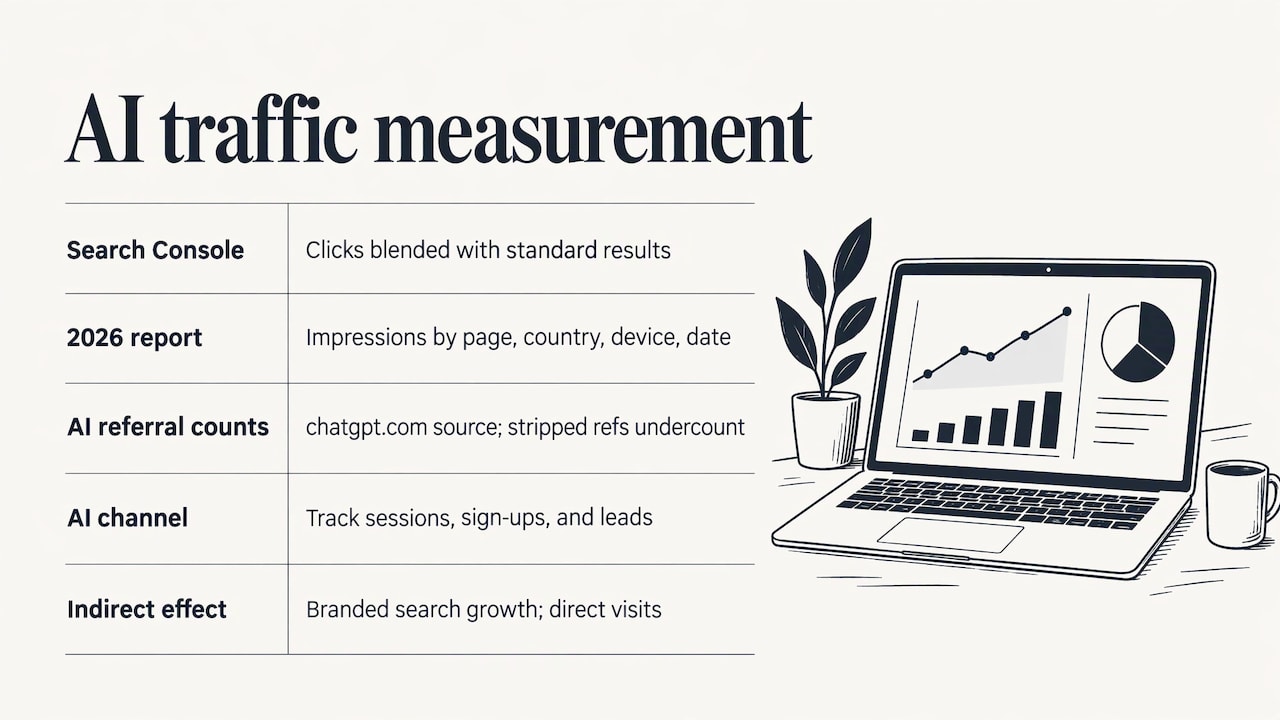
Google’s AI features. Search Console counts clicks from AI Overviews and AI Mode inside the regular Performance report under the Web search type, blended with standard results. Per one detailed walkthrough, Google also added a dedicated report in 2026 that isolates impressions from these features by page, country, device and date. Impressions only, no clicks, so use it to see which pages are being surfaced.
ChatGPT, Perplexity and others. In your web analytics, look at referral sources. A click from a ChatGPT answer on a standard desktop browser arrives with chatgpt.com as the session source, and OpenAI also tags some links itself. Some apps and browsers strip the referrer, so these visits can land in direct traffic. Treat the number as a floor, not the full count.
Create a segment. Group the AI referral sources into one channel so you can watch sessions, sign-ups and leads from it over time. Our post on monitoring AI search traffic covers what you can and cannot measure here.
Also watch for a quieter effect: people see your brand in an AI answer, then search your name or type your URL later. That shows up as branded search growth and direct visits rather than AI referrals.
Step 5: read the results without fooling yourself
A few habits keep the data honest.
- Look at trends over weeks, not days. The analysis above found that the share of cited domains changing in a week ranged from about 5% on Google AI Overviews to about 74% on ChatGPT with web search. Some movement is noise.
- Separate the stable core from the churn. For most questions a small group of domains keeps getting cited. Your first goal is to join that group.
- Report ranges. State the number of runs and the spread, so a drop from 38% to 35% is not treated as a crisis.
- Tie every change to an action. If mention rate rose after you published a comparison page or fixed your schema markup, record it. That is how reporting turns into a plan.
Step 6: turn the findings into work
Tracking that does not lead to changes only documents the problem. When a prompt shows you absent, look for the cause:
- Technical access. Can AI crawlers reach and parse your pages? Check robots.txt, llms.txt and schema markup.
- Answer-ready content. Does a page on your site answer that exact question directly, in the first lines, with specifics?
- Independent mentions. Are you described on other sites the AI draws from? See our research roundup on what drives AI visibility.
- Indexing. Has the content actually been picked up by the engines you care about?
For ChatGPT specifically, our guide on how to rank in ChatGPT walks through the steps.
What we do differently
Monitoring tools stop at the report. Our work starts there. The AI Spider, our proprietary technology, indexes and analyzes your content across 12+ AI search engines, including ChatGPT, Perplexity, Gemini, Claude and Google AI, so the content is recommended and cited rather than only counted. Our team handles the GEO and AEO audit, the technical fixes (llms.txt, robots.txt, schema markup), answer-ready content, YouTube channel and video optimization, and multi-engine AI keyword research. Weekly reporting tracks your performance against competitors.
Perspective
Most brands come to us after looking at a dashboard that says they are invisible, with no one to fix it. A tracker can tell you that ChatGPT skipped you on a Tuesday. It cannot rewrite the page, correct the schema or get the content indexed.
Our view is simple: measurement is the starting line. Because AI answers shift from run to run, you need steady weekly readings, and you need experts acting on them. That is why we run the technical, content and indexing work ourselves and report against your competitors across the major engines, so the numbers show real outcomes.
If your prompt set shows you absent where your buyers ask, that gap is the work list.
Chad
Get the tracking and the fixes in one service
If you would rather not run prompt sets, repeat tests and analytics segments yourself, our done-for-you service takes it on. It is a subscription operated by our team, with no self-serve software to learn. The annual plan is $1,500 per month and the month-to-month plan is $2,000 per month. Details are on our services page.

You can also start with a free AI visibility baseline audit to see where your brand stands today.
FAQ
Can I track AI search rankings like Google rankings?
Not in the same way. AI engines generate a new answer each time, so there is no fixed position to check. The reliable approach is to run a fixed set of questions repeatedly and report how often you are mentioned, cited and recommended.
How many prompts should I track?
A small business can start with 30 to 50 buyer questions covering its main services and comparisons. Larger brands working across several markets may track a few hundred. Keep the list fixed so month-to-month comparisons stay valid.
How often should I check?
Weekly readings suit most brands, with results reviewed as a monthly trend. Because cited sources change from week to week, especially in ChatGPT with web search, a single check can mislead. Weekly reporting is part of our service.
Can I see AI traffic in Google Analytics?
Partly. Visits from links in ChatGPT, Perplexity and similar tools often appear as referrals, but some apps remove the referrer and land in direct traffic. Google’s AI Overviews and AI Mode appear in Search Console, blended into the Web search type in the main report.
Sources
- How to measure AI visibility: mention rate and citations
- Prompt Tracking: measuring AI visibility properly
- AI Overviews and AI Mode in Search Console
- AI Traffic in GA4: how AI referrals show up