Trends in AI Search for 2026: What Brands Need to Know
· Last updated

Trends in AI Search for 2026: What Brands Need to Know
The biggest trend in AI search is that visibility is separating from clicks. AI referrals are still under 1% of website traffic on average, yet AI referral traffic grew 92% year over year worldwide as of July 2026 (75% in the US). Meanwhile, AI answers decide which brands buyers hear about before they ever visit a site. Brands that get named and cited win that early moment. This article covers the shifts that matter for businesses and marketers, what the data says, and what to do about each.
TL;DR
- AI referral traffic is small, under 1% of site traffic on average, but grew 92% worldwide and 75% in the US year over year as of July 2026.
- AI summaries cut clicks: in a Pew analysis, users clicked a traditional result in 8% of visits with an AI summary versus 15% without.
- Each AI engine cites different sources, so one tactic does not work everywhere.
- Your own website is only 5-10% of what AI search references, so third-party presence matters as much as your pages.
- Measure citations and mentions across engines weekly, not just referral clicks.
Table of Contents
- Where AI search stands in late 2026
- Trend 1: AI summaries are reshaping the click
- Trend 2: Shoppers start product research in AI assistants
- Trend 3: Every engine cites differently
- Trend 4: Your own site is a small part of the picture
- Trend 5: Measurement is the unsolved problem
- Trend 6: Strategy is still unsettled, which is the opening
- What to do about these trends
- Our view: act while few brands are
- Get cited, not just tracked
- FAQ
- Sources
Where AI search stands in late 2026
Two numbers frame the year. The first is scale: Graphite’s November 2026 report, covered by Search Engine Journal, puts six AI assistants at 76 billion sessions a month worldwide in September 2026, up 37% year over year. The second is the click gap: US organic search still had 49 times the volume of AI referrals in Q2 2026.
Read together, they say AI search is already a large place where people ask questions, but a small place where they click through. That is why the metric most teams watch, sessions from AI, understates what is happening. The answer itself is the new storefront window.
The reach is wide, too. An academic study of 24,000 queries across 243 countries found that Google’s AI Overview exposure expanded from 7 countries in 2024 to 229 in 2025, and that 67% of US queries were answered by AI in 2025, up from 42% in 2024. McKinsey’s October 2025 report states that about 50% of Google searches already show AI summaries, expected to pass 75% by 2028, and that half of surveyed consumers intentionally seek AI-powered search.
These figures move with each new release, so treat them as the published numbers for their periods. For a running collection with sources, see our AI search statistics page.
Trend 1: AI summaries are reshaping the click
When a search result page includes an AI summary, fewer people leave it. A Pew analysis of US search behavior, cited in the arXiv study, found that users who saw a Google AI summary clicked a traditional result in only 8% of visits, against 15% when no summary appeared. The median zero-click rate (searches that end without a click) was 80% with AI Overviews and 60% without.

The pattern is consistent across sources. Similarweb data reported by Search Engine Journal shows zero-click searches rising from 56% to 69% between May 2024 and May 2025, a rise that lines up with the AI Overviews rollout.
What it means for you: ranking on page one no longer guarantees the visit. McKinsey warns that unprepared brands may see a 20-50% decline in traffic from traditional search channels. The practical response is to be inside the answer, as a cited or recommended source, rather than only below it.
In a Glossy survey of 142 brand and agency professionals in May 2026, 37% of companies reported decreases in upper-funnel search traffic from AI and 21% in lower-funnel traffic. Awareness-stage queries (“what is the best…”) are where AI answers do the most work, and where being named matters most.
Trend 2: Shoppers start product research in AI assistants
The second shift is behavioral. A 2026 survey of regular US AI users by Snipp found that 41.6% say an AI assistant is one of the places they typically start a product search. Search engines still lead at 71.6%, and retailers such as Amazon follow at 45.1%. AI sits ahead of brand websites (26%) and social media (24.2%).
What people ask AI to do is telling:
| Shopping use of AI | Share of regular AI users |
|---|---|
| Compare products | 58.1% |
| Compare prices or value | 47.2% |
| Get recommendations | 46.4% |
| Find deals | 42.2% |
| Research specifications | 41.9% |
| Discover products or brands | 41.5% |
Comparison leads. Buyers are asking AI to narrow a shortlist, which means the brands that appear in that shortlist get considered and the rest are never weighed. McKinsey’s survey found that 44% of AI-powered search users call it their primary and preferred source of insight, ahead of traditional search (31%), retailer and brand websites (9%) and review sites (6%). It also projects that $750 billion in US revenue will flow through AI-powered search by 2028.
For a business, this makes comparison-style content valuable: clear specifications, pricing context, who each product suits, and direct answers to the questions a buyer would type.

Trend 3: Every engine cites differently
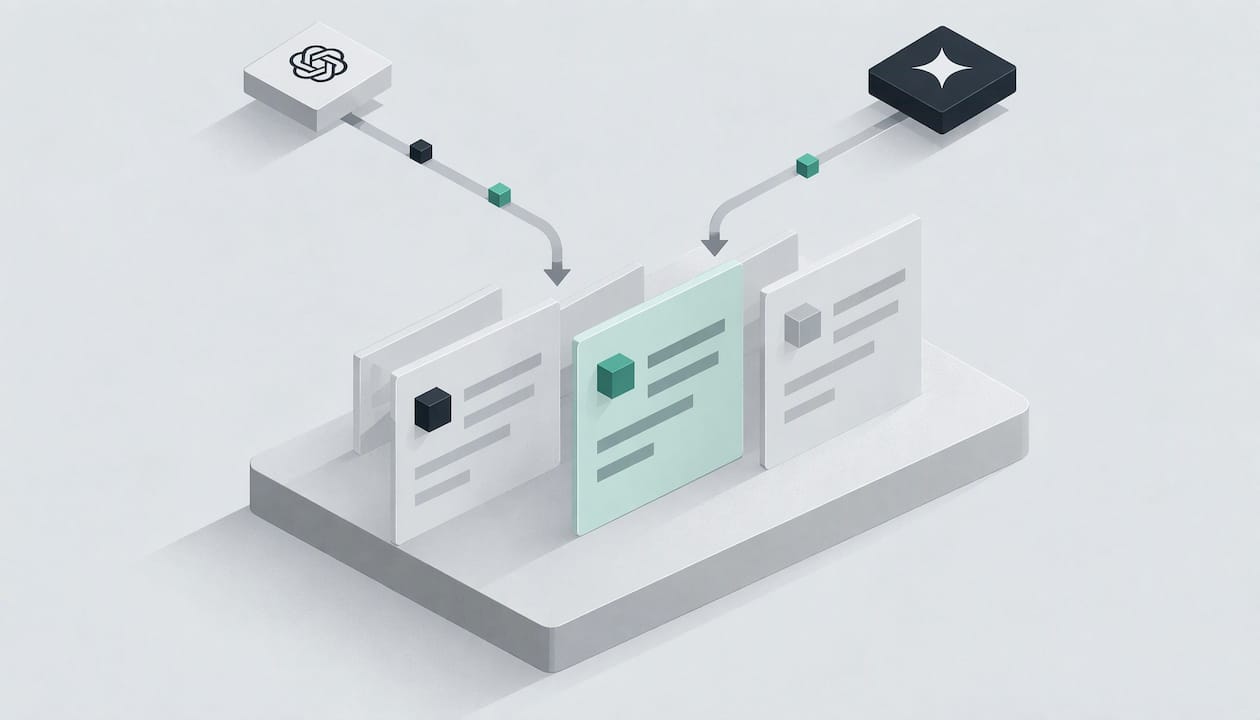
A common mistake is to treat “AI search” as one channel. It is several, and they pull from different places. Search Engine Land reports that engines run background “query fan-out”: they issue extra synthetic queries to gather content before composing an answer. It also reports that ChatGPT and Claude share only about 8% of their citations, so 92% of what ChatGPT cites would not be cited by Claude for the same query.
The source mix differs as well:
- ChatGPT cites community content (Reddit, Quora, forums) in roughly 16% of citations, against less than 1% for Claude.
- Claude favors listicles (36%) and opinion content (13.2%).
Two consequences follow. A brand can be visible in one engine and invisible in another, so tracking has to cover several. And one page rarely does the job: the content types each engine prefers include community discussion, comparison lists and opinion pieces, not only product pages.
This is why our service works across 12+ AI search engines, including ChatGPT, Perplexity, Gemini, Claude and Google AI, rather than a single one.
Trend 4: Your own site is a small part of the picture
McKinsey notes that a brand’s own sites make up only 5-10% of the sources AI search references. The rest is reviews, forums, media coverage, directories, video and other third-party pages. McKinsey concludes that winning brands will need to influence that wider set of sources, not just their own content.
Video is part of that set, which is why YouTube channel and video optimization belongs in an AI visibility plan alongside written pages.
This also changes the technical to-do list. Alongside classic SEO, AI engines reward pages they can read and extract cleanly: sensible robots.txt rules for AI crawlers, schema markup that labels what a page is about, and an llms.txt file that points models to your key content. Our glossary of AI search terms explains each of these in plain language.
For local and small businesses, the same logic applies at a smaller scale, as this overview of AI search and citations for local businesses shows.
Trend 5: Measurement is the unsolved problem
Most teams cannot see what AI says about them. McKinsey reports that just 16% of brands systematically track AI search performance, and that even industry leaders’ generative engine optimization (GEO) results may lag their SEO results by 20-50%. GEO means optimizing content so AI engines find, trust and cite it.
A marketer in the Glossy research described the gap well: the AI platforms do not provide data outputs, and a referral link shows only a fraction of the visibility a brand actually gets. In other words, clicks undercount influence.
Platforms are starting to respond. OpenAI opened ChatGPT Business Hub in beta on November 10, 2026, letting businesses claim their ChatGPT profiles and see how often ChatGPT mentions them and sends clicks. Google made a new model the default for AI Mode on November 12, 2026. Features like these arrive and change often, so a measurement routine should not depend on any single dashboard.
A workable routine tracks, on a weekly basis:
- Whether your brand is mentioned for your core questions, per engine.
- Whether your own pages are cited, and which ones.
- How you compare with named competitors on the same prompts.
- Referral traffic and conversions from AI sources, as a lagging indicator.
Trend 6: Strategy is still unsettled, which is the opening
Most companies have not settled on an approach. In the Glossy survey, 34% of marketers highlighted content that answers consumer questions, 27% had not changed strategy at all, and 16% were unfamiliar with GEO or answer engine optimization (AEO).
Publishers show where the market is heading. A WoodWing MediaVoices 2026 survey found the biggest counter-strategy to falling organic traffic was strengthening owned channels such as newsletters, apps and communities, at almost 60%, followed by answer engine optimization to win AI citations at 40.9%. Brand awareness also matters: people who search for you by name bypass the engines, and strong brand authority supports citations too.
So the early-mover window is real. Few competitors systematically track or optimize for AI answers, and the ones who do compound their advantage as models learn which sources to trust.
What to do about these trends
A sensible sequence for a business, in order:
- Baseline your visibility. Ask the questions your buyers ask across several engines and record who is named. A structured version is our free AI visibility baseline audit.
- Fix the technical layer. Crawler access, schema markup and llms.txt let engines read your content.
- Publish answer-ready content. Write direct, specific answers to buyer questions, with comparisons, figures and clear structure. Our guide on how to optimize content for AI search goes deeper.
- Build presence beyond your site. Reviews, community discussions, listicles and video feed the 90-95% of sources that are not your own pages.
- Track weekly against competitors. Engines change, so the picture does too. Our AI search strategy plan lays out the cadence.
If you want the concepts first, start with our explainer on generative engine optimization.
Our view: act while few brands are
The data points one way. AI answers are where buyers form shortlists, each engine cites different sources, and most brands are not watching any of it. Reports on clicks make AI search look small. Reports on visibility show where the decision is being made.
That is why we do not sell a dashboard. The technical fixes, the answer-ready content, the video work and the indexing are done by our team, because a tracking screen on its own does not change what an engine cites. Our AI Spider indexes and analyzes your content across 12+ AI search engines, and our weekly report shows how you perform against competitors on each one.
The brands that move now will be the ones engines already trust when the rest start paying attention.
Chad
Get cited, not just tracked
Our done-for-you AI search visibility service covers the full list above: a GEO and AEO audit, technical fixes (llms.txt, robots.txt, schema markup), answer-ready content, YouTube optimization, multi-engine AI keyword research and weekly performance reporting against competitors. It is run by our experts, so your team does not need to learn a new tool.
Plans are $1,500 per month on an annual plan or $2,000 per month month-to-month.

FAQ
Is AI search replacing Google?
Not yet by volume. In the Snipp 2026 survey, 71.6% of regular AI users still start product searches in Google or another search engine, against 41.6% for an AI assistant. But Google itself now shows AI summaries on roughly half of searches, per McKinsey, so the two are merging.
Why is AI traffic so small if AI search is so big?
Answers often satisfy the question without a click. Graphite’s data show AI at under 1% of website traffic on average, even as six assistants logged 76 billion sessions in September 2026. Brand mentions and recommendations influence buyers without producing a visit you can count.
What is the difference between GEO and AEO?
Both aim to get your content used in AI-generated answers. GEO (generative engine optimization) is the broader practice across AI engines, while AEO (answer engine optimization) focuses on shaping content so an engine can lift a direct answer from it. In practice a strategy covers both.
How fast are AI search results changing?
Quickly. Engines update models and features often, and the citation mix differs by engine, with ChatGPT and Claude sharing only about 8% of citations. That is why we report weekly rather than quarterly.
Sources
- Graphite AI usage report, via Search Engine Journal
- The Rise of AI Search: Implications for Information Markets (arXiv)
- The Rise of AI Search, full text (arXiv)
- New front door to the internet: Winning in the age of AI search (McKinsey)
- Google AI Overviews impact on publishers (Search Engine Journal)
- Marketers improve GEO strategies amid zero-click (Glossy)
- Snipp 2026 Survey: AI and the Modern Shopper Journey
- 7 AI search shifts you can’t afford to ignore (Search Engine Land)
- Core Update, ChatGPT Business Hub & AI Mode’s New Model (Search Engine Journal)
- Zero-click search forces marketers to optimize GEO (Digiday)
- The Zero-Click Content Shift (WoodWing MediaVoices 2026)